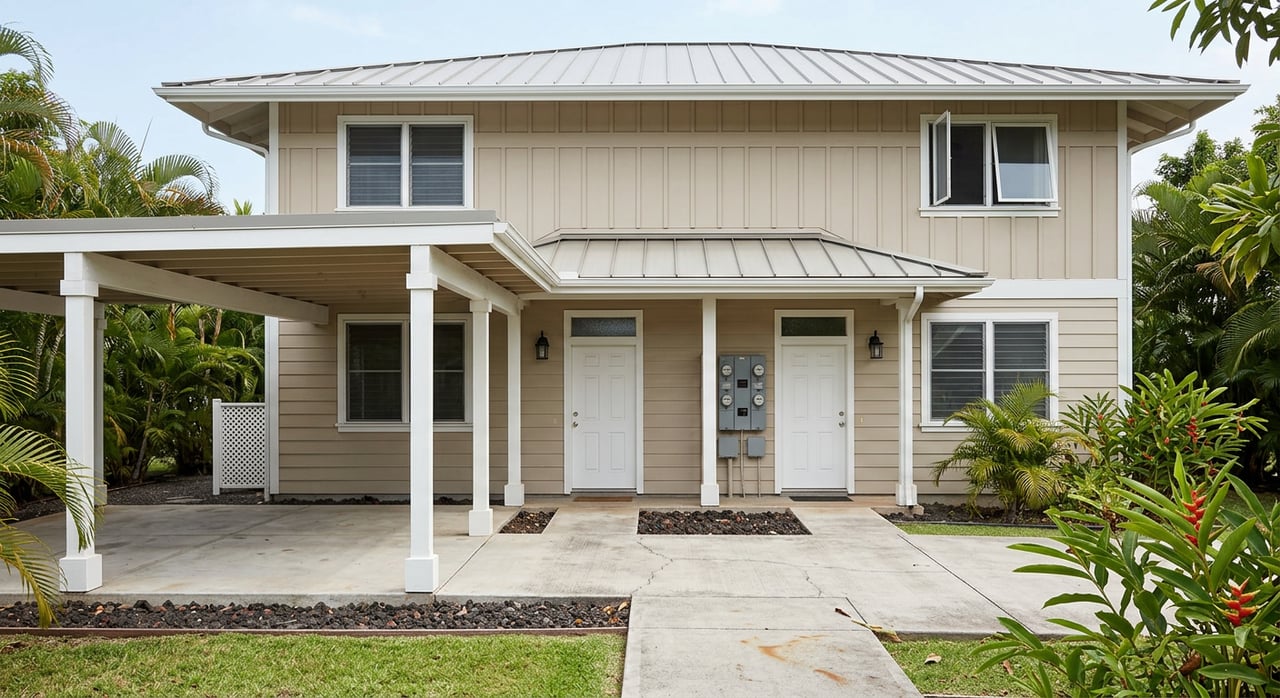
Finding true cash flow on a duplex to fourplex in Honolulu County can feel like threading a needle. Prices are high, expenses can surprise you, and many listings advertise optimistic returns. If you want a small multifamily on Oʻahu that actually pays you, you need disciplined underwriting, local rent benchmarks, and a clear plan for risk. In this guide, you’ll learn a step-by-step process to evaluate deals, realistic rent and expense assumptions, a worked example in Waipahu, and the local pitfalls you must avoid. Let’s dive in.
Cash flow reality on Oʻahu
Honolulu’s stabilized multifamily cap rates tend to cluster in the low to mid 5% range, with small property offerings often marketed around 4% to 6% depending on age and risk. That tight yield environment demands purchase price discipline and conservative assumptions if you want positive cash flow. You can review cap rate context in the latest local reporting from Centre Urban’s Q1 2024 Honolulu insights.
Demand is supported by long-term local factors like high homeownership costs, a tourism and service economy, and a sizable military presence. Those forces help establish a rent floor in many neighborhoods, but they do not erase underwriting risk. Your job is to set accurate rent, vacancy, and expense inputs and then test your returns under realistic scenarios.
Set rent and vacancy assumptions
Start rents with HUD’s Small Area Fair Market Rents (SAFMR) as a conservative baseline by ZIP code. For example, FY2025 lists Ewa Beach (96706) 2-bed around $3,220 per month and Waipahu (96797) 2-bed around $2,410 per month. Use those as a floor, then cross-check active local listings and the property’s rent roll to see what is truly achievable. You can pull the current ZIP-level numbers in the City’s summary of HUD’s FY2025 Small Area FMRs for Honolulu County.
For vacancy, broad apartment data in Honolulu often shows low single-digit rates. For small, older 2–4 unit buildings, underwrite more conservatively. A 5% to 8% vacancy factor is a practical range unless the seller provides strong historical records that support lower turnover and better collections.
Underwrite in five steps
Use a simple, repeatable framework so you compare apples to apples across deals.
1) Set GPR from market rent
- Price each unit at conservative market rent. Start with HUD SAFMR by ZIP, then validate with live listings and the property’s rent roll.
- Add parking, laundry, storage, and pet fees if supported by the submarket.
2) Choose a vacancy factor
- For small Oʻahu multifamily, 5% to 8% is a reasonable underwriting range unless documentation supports better performance.
3) Estimate operating expenses
- Many small multifamily pro formas land near 30% to 45% of effective gross income depending on age, owner-paid utilities, insurance, and taxes. In Hawaiʻi, insurance and energy often push toward the high end.
- Include third-party management at roughly 6% to 10% of collected rent. Add leasing fees separately if applicable.
- Budget replacement reserves around $250 to $800 per unit per year, scaling up for older buildings.
Common Hawaiʻi cost drivers you should highlight:
- Insurance has faced upward pressure since 2023.
- Electricity is among the highest in the nation. If you pay any portion of utilities, this can materially affect NOI.
4) Add other income and utility strategy
- Consider RUBS or separate metering if legal and practical. Confirm metering at due diligence and collect recent utility bills to validate assumptions.
5) Calculate NOI, cap rate, and cash-on-cash
Use these quick formulas to standardize your math:
NOI = (GPR × (1 − vacancy%)) + other income − operating expenses
Cap rate (%) = (NOI ÷ Purchase price) × 100
Cash-on-cash = Annual pre-tax cash flow ÷ Equity invested
Once you have NOI, you can layer in financing to evaluate cash-on-cash and DSCR.
Worked example: Waipahu duplex
Label: Illustrative worked example using conservative assumptions
- Property type: 2-unit duplex in Waipahu (ZIP 96797)
- Purchase price: $990,000 (example price point)
- Rents: 2 units × 2-bed at SAFMR $2,410 per month
- GPR: $4,820 per month, or $57,840 per year
- Vacancy: 7%
- Operating expense ratio: 40% of EGI
Step-by-step results
- Effective Gross Income (EGI): $57,840 × 0.93 = $53,774
- Operating expenses (40% of EGI): about $21,510
- NOI: about $32,264
- Cap rate (cash purchase): ~$32,264 ÷ $990,000 ≈ 3.3%
Financed scenario: 75% LTV, 30-year amortization, 7.0% interest
- Loan amount: $742,500
- Annual debt service: roughly $59,300
- Cash flow before taxes: NOI − Debt service ≈ $32,264 − $59,300 = about −$27,000
- DSCR: ≈ 0.54
How to interpret this
- At a typical small-multifamily price point and SAFMR-level rents, a conservative expense and vacancy profile can produce a cap rate in the low 3% range on a cash basis, with negative cash flow once you add common investor financing terms.
- To reach mid-5% cap targets or positive cash flow with financing, you usually need at least one of the following: a meaningfully lower purchase price, verified rent upside above SAFMR, or a value-add plan that raises income and manages expenses.
Where to find upside
You can still find solid, cash-flowing small multifamily on Oʻahu if you focus on controllable levers.
- Buy under market: Target properties with longer days on market, functional issues you can fix, or motivated sellers. Price discipline is your strongest tool in a low-cap environment.
- Verify real rents: SAFMR is a floor, not a ceiling. Cross-check with current listings and the rent roll. Some micro-pockets support higher asking rents than the HUD baseline.
- Execute light value-add: Improve unit finishes, fix deferred maintenance, add or optimize laundry, storage, or parking income where practical.
- Optimize utilities: Separate meters or implement RUBS if allowed and supported by the building’s layout and leases. Account for Oʻahu’s high electricity costs when modeling.
- Consider owner-occupant FHA for 2–4 units: If you plan to live in one unit and qualify, FHA loan limits are higher for small multifamily than for single units and can improve your payment structure. Always confirm current limits and rules directly with HUD. Review FHA policy highlights in HUD’s announcements on FHA loan limits.
- Do not assume short-term rental conversion: Honolulu’s rules are strict. Treat STR income as zero unless you verify legal status and transferability.
Local pitfalls to avoid
Permits and unpermitted work
Unpermitted additions and conversions are a recurring issue. The Department of Planning and Permitting (DPP) can issue daily fines and require retroactive permits or removal. Always request permit history and DPP clearance. Recent enforcement coverage explains why this matters for buyers in Honolulu Civil Beat’s reporting on unpermitted work enforcement.
Short-term rental rules
Outside resort zones, whole-home STRs are generally prohibited unless the property holds a valid Non-Conforming Use Certificate or other specific registration. Do not model STR income without confirming status in the Land Use Ordinance. You can review the rules in the City and County of Honolulu’s LUO.
Property tax classification
Tax class affects your annual carry. Many rentals fall into Residential A with tiered rates. Verify the classification and add current taxes to your expense line. See the City’s guide to Residential A information.
Insurance and energy costs
Insurance premiums have been volatile since 2023. Confirm availability and pricing with your insurance broker early in due diligence. A recent legislative context note highlights market strains in Hawaiʻi’s insurance environment; review the discussion in the state’s materials at data.capitol.hawaii.gov.
Hawaiʻi also has the highest average retail electricity prices in the U.S., which can materially increase owner-paid utilities. Factor this into your pro forma and lease structure. Get familiar with local energy costs via the U.S. Energy Information Administration’s Hawaiʻi profile.
Flood and coastal risk
FEMA has updated flood maps for Oʻahu. If a property is mapped into a Special Flood Hazard Area, lenders may require flood insurance and premiums can be meaningful. Review changes and outreach notices at Wai Hālana’s update on FEMA’s new maps.
ADUs and ohana units
A permitted ADU can boost income if it is legal and properly documented. An unpermitted ADU is a red flag for financing and title. Verify permit history with DPP before underwriting any ADU income.
Landlord-tenant rules
Hawaiʻi’s Residential Landlord-Tenant Code governs deposits, notices, and remedies. Understand timelines and requirements before making assumptions about rent collections or eviction risk. See the DCCA’s overview of HRS Chapter 521.
Due diligence checklist
Use this list to reduce surprises and protect your returns.
- Pull DPP permit history and confirm no open violations or fines.
- Read the full rent roll and collect 12 months of receipts or bank deposits.
- Download HUD SAFMR for the ZIP and compare with active rental listings.
- Check TMK records, confirm property tax class, and review the current bill.
- Confirm utility metering and collect 12 months of electricity, water, and sewer bills.
- Inspect roof, structure, drainage, and pest/termite conditions; budget reserves.
- Confirm insurance availability and premiums with a written quote.
- Verify STR status in LUO and do not model STR income without legal proof.
Financing and exits
- Owner-occupant FHA for 2–4 units can improve loan terms if you live in one unit and meet all rules. Always verify current limits and program details with HUD.
- Investor financing may rely on DSCR underwriting and often carries higher rates than primary-home loans. Many lenders look for a minimum DSCR in the 1.1 to 1.25 range; model your NOI and debt service carefully.
- Common exits include long-term hold, rent stabilization and sale to local investors, or value-add repositioning. STR conversion is usually not an option unless you have proper legal status.
Your next step
If you want a small multifamily on Oʻahu that pays you back, build your pro forma from conservative rent floors, realistic expenses, and verified local rules. Then move fast when numbers pencil. If you would like help sourcing deals, validating rents, and pressure-testing your underwriting, reach out to Fran Magbual for a local, high-touch game plan.
FAQs
What cap rates should I expect on Oʻahu small multifamily?
- Many stabilized offerings market near 4% to 6% cap rates, with risk, age, and expenses driving variance. Buying well and managing expenses are key to improving returns.
How do I estimate rents for Waipahu and Ewa Beach?
- Use HUD’s ZIP-level SAFMR as a conservative floor, then verify with live listings and the rent roll. For FY2025, Waipahu 2-bed is about $2,410 and Ewa Beach 2-bed is about $3,220.
Can I convert a duplex to a short-term rental in Honolulu?
- Usually not. Outside resort areas, whole-home STRs are generally prohibited unless the property holds a valid, transferable authorization such as a nonconforming use certificate.
Which expenses tend to be highest in Hawaiʻi?
- Insurance and electricity often run higher than many mainland markets. Build quotes into your pro forma and confirm metering so tenants pay their fair share where allowed.
Can I use FHA to buy a 2–4 unit in Honolulu County?
- Yes, if you will occupy one unit and meet FHA rules and loan limits. This can improve payments but still requires conservative underwriting.
How do I check the property’s tax class and impact on cash flow?
- Review the City’s Residential A guidance, confirm the current tax bill, and update your expense line before you finalize a purchase price.