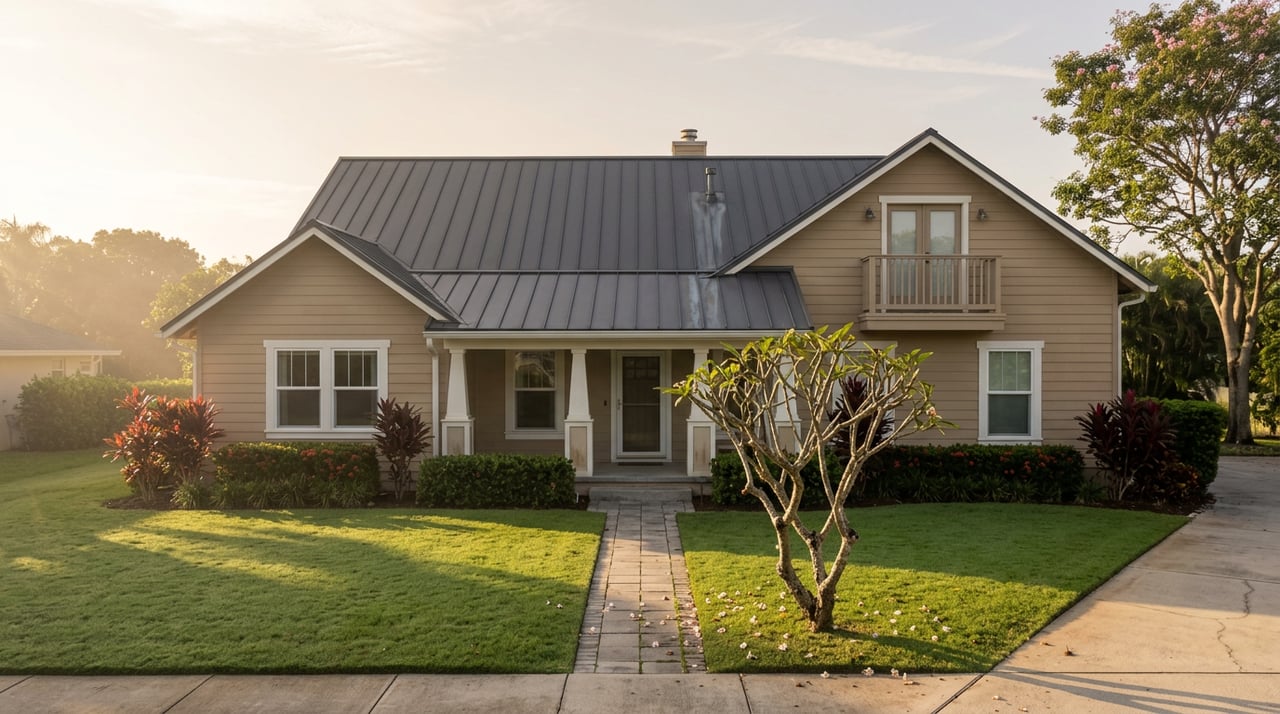
Walk two model homes on the same street in Ho'opili and you'll see the same floor plan, the same finish package, the same list price on the sign out front. What you won't see, unless you ask for it, is the one-page fee disclosure sitting in the sales office binder. On one street that page says $65 a month. On the next street over, same phase of the same master plan, it says $350 or more. Nobody mentions this on the drive-through tour. It only shows up when you ask for the CC&Rs.
That gap is the whole story of comparing new construction in Kapolei right now. Buyers shopping Ho'opili, Kapolei's build-out, and nearby Koa Ridge tend to line up list prices side by side and assume the number on the sign is the number that matters. It isn't. Two structural costs sit underneath that sticker price, and neither one shows up in a portal search filter. One is a fee structure that can swing your monthly bill by hundreds of dollars within the same development. The other is a state exaction that has been quietly shrinking for the past year, which means the price you're comparing today may already reflect relief that older resale comps never had.
The line item nobody compares
Ho'opili, D.R. Horton's roughly 1,500-acre master plan stretching between Ewa Beach and Kapolei, uses what's called a two-tier HOA structure. Every homeowner in the community pays a master association fee, somewhere in the neighborhood of $59 to $82 a month depending on the phase, which covers the pools, parks, and shared landscaping that make the whole development function. That part is consistent no matter what you buy.
The second tier is where the comparison falls apart. Traditional single-family neighborhoods within Ho'opili, places like Ho'oulu, I'liahi, Ikena, and Kanalani, carry no additional neighborhood fee at all. Buy there and your total HOA obligation is just the master fee. But townhome and condo phases, Kohina among them, layer on a neighborhood-specific maintenance fee that can run $350 a month or higher, because those buildings share roofs, exterior walls, and structural systems that a detached single-family lot simply doesn't have.
Here's what that looks like when you put two Ho'opili products side by side:
| Community / Phase | Home Type | Master Fee | Neighborhood Fee | Typical Monthly Total |
|---|---|---|---|---|
| Ho'oulu, I'liahi, Ikena, Kanalani (Ho'opili) | Single-family | ~$65 | $0 | ~$65 |
| Kohina (Ho'opili) | Condo/townhome | ~$65 | up to $350+ | up to $415+ |
| Nanea (Koa Ridge) | Single-family | ~$67 | ~$50 | ~$117 |
| Condo phases (Koa Ridge) | Condo | ~$67 | $378–$600 | ~$445–$667 |
This isn't a Ho'opili quirk. Koa Ridge, the roughly 3,500-home master plan between Mililani and Waipio, uses the same two-tier model with nearly identical math: a modest shared fee everyone pays, then a product-driven fee that separates single-family owners from condo owners by hundreds of dollars a month. Once you see the pattern in one master plan, you recognize it in the next.
Over a 30-year mortgage, a $300-a-month gap is not a rounding error. It's roughly $108,000 in payments over the life of the loan, money that never shows up in the price-per-square-foot comparison most buyers run first.
Why the fee splits this way
The logic is straightforward once you know what's driving it. Single-family homes on their own lots don't require the HOA to maintain a roof, a shared foundation, or a building envelope. The owner handles that. Condo and townhome buildings do require it, because the association, not the individual owner, is responsible for the exterior of a structure that multiple households share. That responsibility gets funded through the neighborhood fee, and it's also why HOA fees tend to climb over time. Ho'opili's fee guidance notes that increases in the 3 to 5 percent range annually are typical, plus the possibility of special assessments if something unplanned needs repair. A $65 fee today is not a promise the fee stays $65.
There's a second reason to actually read the reserve study before you write an offer, and it isn't unique to Ho'opili. In Hawaii, unpaid HOA dues can result in a lien, and associations here do have foreclosure authority for delinquent accounts. That's a real consequence, not a formality, which is exactly why the fee schedule deserves the same scrutiny as the interest rate.
The other hidden line: school impact fees
The HOA fee is the cost you can see if you ask. The second one is baked into the price before you ever walk into the sales office.
Since September 2013, home builders in Aiea, Pearl City, Waipahu, Ewa, and Kapolei have been subject to a Leeward Oahu school impact fee on every new residential building permit: $5,504 for a single-family unit, $4,334 for a multi-family unit. The fee was created by a 2007 state law that let Hawaii's Department of Education designate impact districts anywhere new housing was expected to strain school capacity, and Leeward Oahu became one of only five such districts statewide. Most builders don't itemize it. They fold it into the price like any other development cost.
Occasionally a builder does itemize it, and the reaction tells you how invisible this fee usually is. When Howard Hughes Corp. began charging the fee as a separate closing cost at its Ko'ula tower in Kakaako, buyers pushed back even though the fee was disclosed in their sales contracts. "Some buyers are surprised," a Honolulu agent told the Star-Advertiser in 2022, because most developments never make the fee visible enough to notice.
What changed in 2025 and 2026
Here's the part that almost no Ho'opili or Kapolei pricing guide has caught up to yet.
Reporting from Honolulu Civil Beat found that the state had collected school impact fees since 2007 and had not spent a single dollar of it. Lawmakers took that as a sign the program wasn't working as designed, and in 2025 the legislature passed Act 268, which repealed the construction-cost component of school impact fees and exempted Department of Hawaiian Home Lands projects, certain affordable housing developments, and single-room dwellings from the fee entirely. This spring, a follow-up bill, HB1713, was moving through the legislature with backing from the Grassroot Institute of Hawaii, aiming to repeal school impact fees altogether, return the money already collected to a school facilities fund, and stop new education-related exactions on homebuilding statewide.
None of this means school impact fees are gone in Kapolei today. It means the fee that has been quietly embedded in every new-construction price in this district since 2013 is now smaller than it used to be, and the direction of travel is toward smaller still. A builder pricing a 2026 release in Ho'opili is working with a different cost base than a builder priced a 2019 release in the same community, even if the square footage and finishes look identical. That's relevant if you're comparing a new-construction list price against an older resale in the same neighborhood and wondering why the math doesn't quite line up.
How to actually compare two West Oahu new-construction options
The fix isn't complicated, but it does require asking for documents most buyers never request until after they've already picked a favorite.
- Ask for the phase-specific CC&Rs and current HOA dues in writing, not the verbal range quoted at the sales gallery. The master fee and the neighborhood fee are usually two separate line items, and only one of them is the same across the whole community.
- Request the reserve study. It tells you whether the association is funded for the roof and exterior repairs that come due in year 10, or whether a special assessment is likely.
- Ask your agent or the builder whether the price you're quoted reflects a permit pulled before or after 2025, since that determines which version of the school impact fee applied to that specific unit.
- Run the full monthly number, mortgage plus master fee plus neighborhood fee plus property tax, before comparing two communities on price alone. A lower list price with a $350 neighborhood fee can cost more per month than a slightly higher price with no neighborhood fee at all.
Frequently asked questions
Does every Ho'opili neighborhood charge an HOA fee? Every homeowner pays the master association fee, roughly $59 to $82 a month depending on the phase. Whether you pay anything beyond that depends entirely on whether you buy a traditional single-family home, which typically carries no extra fee, or a townhome or condo product, which does.
Are school impact fees going away completely? Not yet, but they've already been scaled back. Act 268 in 2025 removed the construction-cost portion of the fee for most projects, and a 2026 bill sought full repeal. Ask your agent whether the specific permit you're buying was priced before or after that change.
Is a lower HOA fee always the better deal? Not automatically. A single-family phase with no neighborhood fee also means no shared fund for exterior maintenance, since you're responsible for your own roof and structure. A condo fee of $350 a month is paying for something a single-family owner is budgeting for separately, just less visibly.
Comparing new construction in Kapolei takes more than a price-per-square-foot spreadsheet. It takes someone who reads the fee schedule before you fall for the model home. That's the kind of digging List With Fran Mag does on every West Oahu comparison, so reach out for a free home valuation or a one-on-one consultation before you sign anything at the sales gallery.