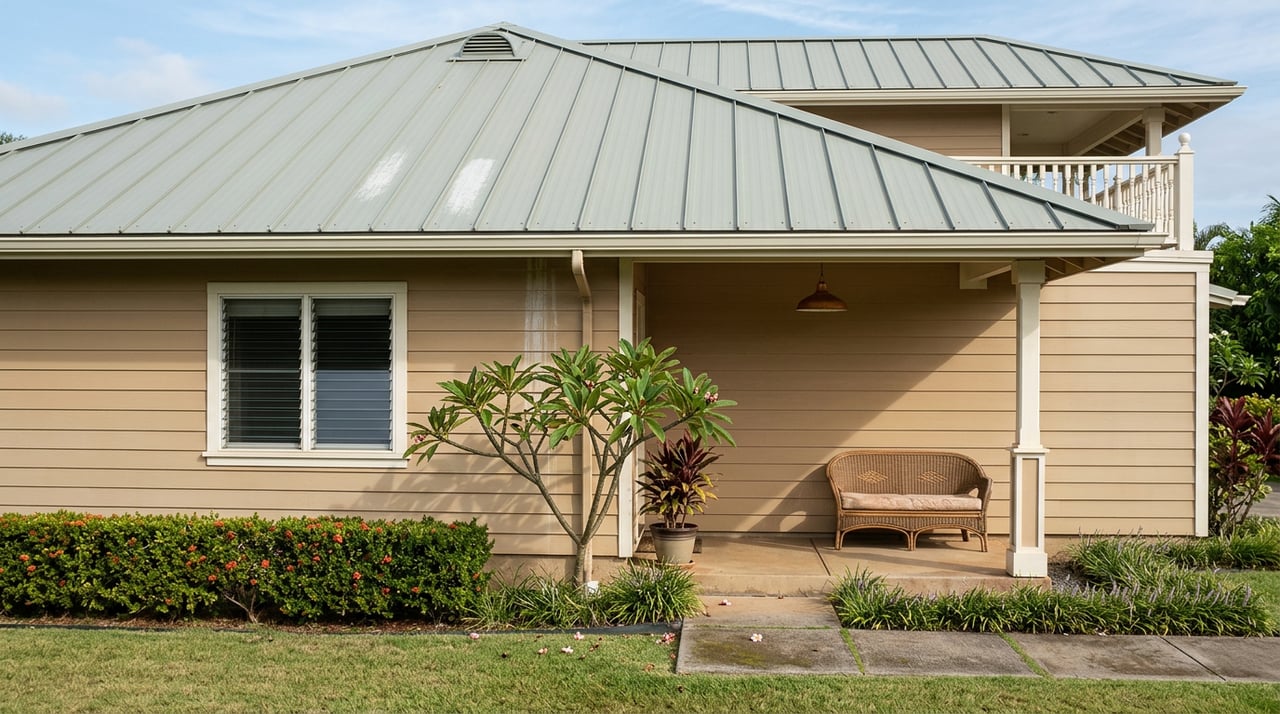
A Hawaii landlord opened a letter this spring and found out their hurricane coverage was gone. Not canceled for a claim, not raised for a bad roof inspection. The letter said the house was single-wall construction and that was reason enough. Their old combined property and hurricane premium had run just above $1,700 a year. The replacement quote, from a surplus-lines carrier called Centauri Specialty, came in above $2,300 for hurricane coverage alone, according to a report from Hawaii News Now published in late May 2026. That is more than $100 added to the monthly cost of holding onto a rental property, and the letter offered no explanation beyond the construction type itself.
State Farm is Hawaii's dominant insurer, and this spring it stopped renewing hurricane policies specifically on single-wall wood-frame homes that are rented out. Nowhere on the island does that decision land with more weight than in Waipahu, because Waipahu is where single-wall construction started.
The style was born here
The single-wall house, thin tongue-and-groove board serving as both structure and finished wall with no cavity for insulation, took shape in the plantation camps around the turn of the last century as sugar operators needed cheap, fast housing for waves of arriving laborers. A 1983 PBS Hawaiʻi documentary on the technique traced its earliest surviving examples to a home site standing within a mile of the old mill stack in Waipahu. The pattern spread from there through the other sugar towns, but Waipahu is where the archive points first.
That history is not decoration. It is still standing. Waipahu Gardens, the neighborhood built out north of the Waipahu Street exit between Naval Access Road and Wainui Road, went up in the 1960s as single-story, single-wall ranch homes, many with only one to one and a half bathrooms before later remodels. Crestview, where every street name starts with "Lumi," dates from the mid-to-late 1960s with the same wood-frame build and simple two-car carports. Robinson Heights, sitting between Harbor View and Waipahu Gardens, is largely 1960s stock as well, aside from a small cluster of newer CPR homes on Koalea Street known as Sugar Mill Estates. Waipahu Triangle runs from the late 1950s through the 1970s. These are not scattered outliers. They are a meaningful share of Waipahu's detached single-family inventory, which is exactly why an insurer decision about construction type does not stay abstract here the way it might in a neighborhood full of newer double-wall builds.
What actually changed this year
The mechanism is straightforward once you see it. Hawaii mortgage lenders require hurricane coverage as a condition of closing and of keeping the loan current. That has not changed. What changed is which insurers are willing to write that coverage on single-wall homes once they are used as rentals. State Farm's decision, confirmed in the same Hawaii News Now reporting, applies to rented single-wall houses specifically, and the company framed it as managing exposure to a construction type it considers more vulnerable across multiple perils, hurricanes included.
State Insurance Commissioner Scott Saiki called the shift predictable, noting that these homes carry a higher risk of sustaining damage. He also argued the long-term effect could be healthier for the market, as more carriers spread the risk and compete for the business that State Farm is stepping back from. That is a reasonable regulatory read. It does not change the math for a Waipahu owner standing at the closing table this month.
The urgency is not theoretical either. Tropical Storm and Hurricane Lala struck the islands in August 2026, and the Hawaii Insurance Division issued a formal memorandum on August 26 directing every property insurer authorized to do business in the state on how to handle the resulting claims, including how to apply hurricane deductibles versus standard wind deductibles depending on watch and warning timing. The single-wall coverage question is not a lingering academic worry. It just got tested by a real storm.
Here is what that change looks like in dollars, based on the one documented case from this spring:
| Combined property and hurricane premium | |
|---|---|
| Prior State Farm policy | ~$1,700/year |
| Replacement hurricane-only quote (Centauri Specialty) | $2,300+/year |
That gap is why a buyer who assumes hurricane insurance is a formality, something the lender's checklist handles automatically, can find out three weeks into escrow that the standard path just closed.
Why rentals feel this first
The distinction matters for anyone thinking about Waipahu as an investment rather than a primary residence. State Farm's move targets rented single-wall homes, not owner-occupied ones. An owner who lives in a 1960s Crestview or Waipahu Gardens house is not currently facing the same non-renewal letter. A landlord holding the identical house as a rental is.
That asymmetry lands squarely on the kind of property that shows up often in these older Waipahu subdivisions: a main house with an added ADU, a multi-bedroom home marketed for multi-generational living or as a care home, the small-scale rental stock that has always made Central Oahu attractive to investors working with modest budgets. If you are underwriting a Waipahu duplex or a house-plus-ADU as a rental in 2026, the insurance line item in your pro forma needs to reflect a possible move to a surplus-lines carrier, not the legacy admitted-market premium you might be pricing from an older listing.
A fast market makes this easy to miss
The reason this friction catches people off guard is that Waipahu's single-family market does not look like a segment with hidden problems. In the twelve months ending June 2026, Waipahu homes sold in a median of just 14 days, and 40.3 percent of sales closed above asking price, per Locations Hawaii's monthly tracking of Oahu submarkets. That is a genuinely hot, fast-moving corner of the island. Waipahu condos told a different story over the same period: median days on market stretched to 35, months of remaining inventory rose to 2.8, and the median price actually slipped 3 percent to $480,000, while the single-family median held near $950,000.
A market moving that fast on the home side pressures buyers into waiving contingencies to compete. That is precisely the environment where an insurability problem tied to construction type, not condition or price, gets discovered too late. A house can be priced right, staged well, and under contract in under two weeks, and still turn into a financing scramble once the hurricane binder request goes out.
What actually brings the number down
The upgrades that move the needle are specific and geographically relevant. Dennis Hwang, co-author of the state's guide to hurricane strengthening, told Hawaii Public Radio in late August that a single-wall house in Central Oahu that adds a hurricane roof-to-wall tie along with foundation upgrades can save up to $600 a year on premium. Hurricane clips alone, tying the roof to the walls, can qualify a home for a discount around 10 percent with many carriers.
For owners who have already received a non-renewal letter or are quoting a replacement policy, a few concrete paths exist:
- Ask an independent Hawaii insurance brokerage to quote standalone hurricane coverage rather than assuming a bundled homeowners policy is the only option.
- Look specifically at carriers built around the state's older housing stock. Hawaiian Hurricane Group, for example, designs coverage around single-wall and pre-code homes and folds in ordinance-or-law protection that many standard policies exclude, meaning the cost of bringing a damaged home up to current code would otherwise come out of pocket.
- Get a written quote for hurricane coverage before removing a financing or inspection contingency, not after.
Before you sign anything
If you are buying, selling, or holding rental property in one of Waipahu's older subdivisions this year, a short list of questions belongs in your pre-offer or pre-listing conversation:
- Is the home currently rented, or would it be purchased as a rental? That single fact changes which insurers will even quote it.
- Has the current owner received any non-renewal notice tied to construction type in the past 12 months? Sellers are not always required to volunteer this, but it is worth asking directly.
- Has the roof, roof-to-wall connection, or foundation been retrofitted with wind mitigation features? That work can be the difference between a standard quote and a surplus-lines placement.
- Does your lender's hurricane insurance requirement have a hard deadline relative to your closing date? Build in enough runway to shop the coverage rather than accepting the first quote under time pressure.
Frequently asked questions
Does this affect owner-occupied single-wall homes in Waipahu, or only rentals? Based on current reporting, State Farm's non-renewal decision this year applies specifically to rented single-wall homes. Owner-occupied single-wall houses are not currently subject to the same letters, though owners should still expect premiums generally to keep climbing given the broader rate pressure across the state.
How do I find out if a specific Waipahu house is single-wall construction? Construction type is typically noted in the seller's disclosure and can often be confirmed through the county's property records or by asking directly during a home inspection. Given how common single-wall building is in neighborhoods like Waipahu Gardens, Crestview, and Robinson Heights, it is worth asking early rather than assuming.
Is this just a Waipahu problem? No. Single-wall construction is common across many older Oahu neighborhoods, and the insurance shift applies statewide. Waipahu carries extra weight in this conversation because of its role as the place where the construction style originated and because so much of its detached housing stock still reflects that history.
If you are weighing an offer on an older Waipahu home, thinking about a rental purchase in Crestview or Waipahu Gardens, or trying to figure out what a non-renewal letter means for a property you already own, I would rather walk through the actual numbers with you before you are under time pressure in escrow. You can reach out through List With Fran Mag for a straightforward conversation about what a specific address is facing and what your options look like.